Let me skip ahead in the story for a moment. The reason for this blog is not to evidence how crazy I am but to maybe help folks in a similar situation to make sound decisions and showcase some of the boat work processes, the maintenance work, and whatever you might want to know that can be demonstrated using this boat.
O.k., back to my comfortable chair in front of my computer: There was extremely little information available about the boat. It is a C&C Custom 62, center cockpit, pilothouse version built in 1982. Not much comes up when you google this information, except the sale pictures and a Wikipedia entry about C&C Custom 62. Two boats were mentioned, one built in 1981 with an aft cockpit “Jubilation” and one built in 1982 with a center cockpit, “Pegaso”. The boats were designed by Robert W. Ball of C&C Design for long-range cruising. (*UPDATE: There are some issues with the “Jubilation” entry on that page, see my other post about it)
This is not the “Jubilation” this is the “Pegaso”. You are looking at the only other 62’ C&C and a one-of custom-built boat. We have a name.
What is the history?
Thanks to Ken Heaton, who was instrumental in building the Wikipedia article for the Custom ‘62, I got the names of Bill and Alicia Blodgett and their book about cruising around the world in “Pegaso”, The book revealed the original owners were Jorge and Herta Altamirano who also sailed around the world in this boat.
So some story is developing about “Pegaso” from the days before the Internet.
1981 Custom design for Jorge Altamirano of California by Rob Ball of C&C Design
1982 Construction by Custom Division of C&C Yachts in Canada
1983 Yachting Magazine article by David Weatherstone
1983-1992 Circumnavigation with the Altamiranos
1992-2001 Second circumnavigation with the Blodgetts
Then it gets thin … Bill Blodgett informed me that they donated the yacht to a charity that teaches marine skills to “at-risk” young people in Newport, RI in 2001. It is not clear at this time if this was a donation to generate money for the charity or if the boat was actually used by the school to teach sailing and boat work. It seems not the right layout for that, but that is just IMHO.
Anyway, between a reported sighting in 2004 in Newport, there were no other notable events. I found a mooring slip on the boat from that time.
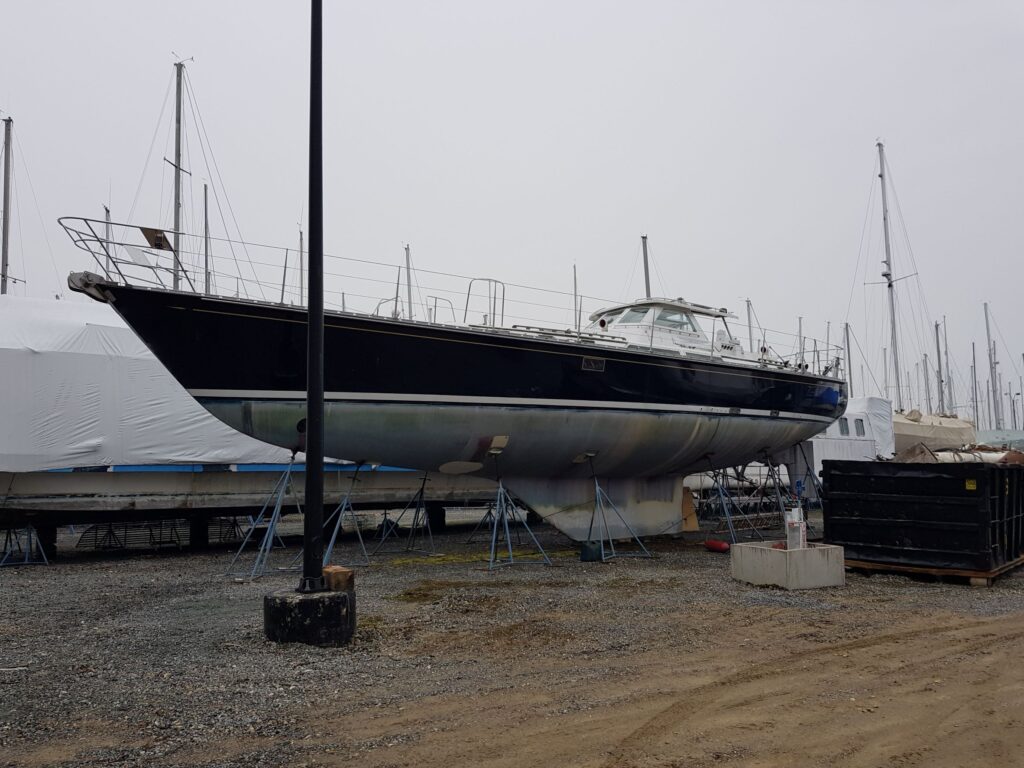
When I talked to the marina where she is today, that last gap was filled. A previous owner, not clear who that was, started a complete retrofit in 2005, taking the masts off, the engine out, adding a bow thruster, and promptly running out of money or never having it in the first place. “Pegaso” has been sitting here at Herrington Harbour North on the dry since 2005 and it is now February 2019: that is 14 years!! The marina got eventually possession of the boat (we’re stuck with it) and it’s only saving grace was that she is actually in not too bad of a shape, but time is running out.
So, while this is all very exciting, there are clearly a lot of flags going up that need to be considered.
- For 14 years people looked at her and decided that is too big of a project.
- What happened over the years to the masts, sails, engines, winches, …?
- Are there any structural issues that are not visible?
- What is the budget and does it make sense to spend it on a 40-year boat?
- Where do you find the time and money to rebuild this?
- Where do you rebuild this?
For 14 years people looked at her and decided: That is too big of a project.
It is a massive project 62’ 1” length (l.o.a), 15’2 ½” beam (that is the widest width of the boat), a draft of 8’ (the depth of water when you hit the bottom), and a displacement of 65,000 lb. The displacement is the weight of the amount of water it displaces when in the water. The ballast (weight under the boat, to keep the boat upright) alone is 28,000 lb, which is roughly 14 tons! All these are original specification data, not counting that both masts, engines, generators, sails, anchors, chains… are missing.
The interior looks surprisingly good, the dishes and silverware are still there and there is still 14-year-old Jello and cookies in one of the cabinets.
What happened over the years to the masts, sails, engine, winches, …?
According to the marina, they were sent to various shops 14 years ago, who never got paid for their services, and finally sold off or re-purposed everything. Some of the items missing might have been stolen over the years.
How do you get information on what was in the boat in the first place? This is a custom boat! Well, there is the “Jubilee”, the 1981 version, but it is an aft cockpit and a 6’ draft so while both boats are ketch rigged and the masts could be copied, there might have been some differences between the boats.
If you look at the Wikipedia article about C&C Yachts and read the line: “On 21 April 1994 a fire broke out in the factory, completely destroying the production line, most of the tooling, records, and plans. The 1:30 a.m. blaze tore through C&C’s production sheds and block-long warehouse that housed the production equipment and fiberglass materials.” That, while 12 years after the construction is a scary thought about the plans.
Fortunately, Rob Ball was still available and very responsive to my questioning. He mentioned that C&C plans were acquired by Tartan Yachts and ultimately ended up at the Marine Museum in Ontario Canada. The Marine Museum is still up and running, although they recently changed location and they are eager to answer any questions about C&C since it is part of the Canadian maritime history they cover. The contact there is Doug Cowie, the manager of the museum. A couple of e-mails and Doug responded with a list of 30 design sheets they had found and cataloged with a potential 20 more that are in storage. It’s up to the scanner and for a very reasonable fee, he will send the documents electronically.
Doug seemed to welcome the news that the location of “Pegaso” was known, she still existed, and that we could put a “face” to the plans in the museum’s possession.
I am so looking forward to seeing the plans in a few days.
Are there any structural issues that are not visible?
It doesn’t look so and the story to “go through a refit” kind of suggests that the previous owner wanted to restore the vessel and not just repair the damage. The marina had 14 years to scrap her if there was irreparable damage. All good circumstantial arguments, but an expert opinion is needed. Of course, a certified marine surveyor costs real money but better some money now than a lot of money later.
What is the budget and does it make sense to spend it on a 40-year boat?
That is really a good question. Cruising boats of that age were built a little tougher than today’s mass-production boats, but in 2022 this boat will be 40 years old. Nothing in comparison to some old wooden boats, but still, how long does fiberglass last before it becomes a structural problem?
My initial primary goal was to cruise a little in five years or so, the Caribbean mostly, and maybe venture a bit further.
Until then I could work in my job off the boat with decent enough internet, so would use it as a live-aboard platform.
The marina estimate was 200K to get her back into ship-shape, that might have been a sales estimate.
Let’s go with it and see what it gets us. I obviously would be O.K. with that investment, to spend 200K for a mobile beach house.
The somewhat sister ship, the “Marauder”, was listed in 2011 for $379,000.-. The “Marauder” entered the water in 1981 as “Jubilee”, then was renamed “Djinn”, then “Marauder” and now “Lilia”, according to Coast Guard records. This is the only other C&C 62 out there. I also have a German listing of the Marauder, located in Spain, that is asking $500,000.-. The date of the listing was not available. (UPDATE: see thee article about the controversy if the “Marauder”/”Lilia” listed on the Wikipedia page is actually a C&C)
So a used value of $200,000- 250,000 in 2020 seems to be in line with a comparable price. On the upside, since there is so much missing in the boat we have the opportunity to upgrade to current technology and we don’t even have to remove the old stuff.
New masts and rigging, sails, engine, electrical system, and other running gear, must be worth something more. I am for example planning to install newer LiFePO batteries instead of lead-acid and maybe eliminate the need to have propane on board.
After some heavy thinking, I commit to the purchase. The marina is “holding the title for a year” since they must have had experience with people buying, then losing interest, and walking away. It is not that easy to repossess ownership based on years of non-payment of the land storage, so I agree with that.
Anyway, negotiations went in my favor and I get to experience the common paradigm that: “The cheapest boats are the most expensive”.
UPDATE:
I wrote most of the above passages between 2019 and 2020. It is now 2022 and we are still working on the boat. 2019 was mostly a year of triage and damage assessment. Triage to get the once duct-taped winch and windlass bolt holes sealed, and standing water pumped out of the bilges. Damage assessment to get a better picture of what we are dealing with.
As mentioned before, the engine, the original Caterpillar engine, and the two Onan Generators were already gone. The Cat is allegedly rusting in the backyard of some mechanic that did not get paid for his work. The masts were missing. I don’t know anything about the mizzen but the main was laying in storage at Annapolis Rigging for many years. Jay, the owner told me he offered it to the marina for $8,000 to cover his cost and to keep the mast with the boat, but the marina declined. I have a split feeling about that. On one hand, a mast for this boat, even if it has to be re-rigged, for $8000 is a deal, a lot less than what we ended up paying for a new mast. On the other hand, if that was the original mast, there must be at some time the need to replace the gear. In any case, the mast ended up being sold and shipped to Europe.
During the damage assessment, most of Pegaso’s extensive spare parts were found, as well as the soaked courtesy flags of the Blodgett trip. The full set of blueprints of the boat made it – unscathed – in a dry compartment as well as 2 folders of repair bills and manuals for the old instruments and devices, some no longer on board. The important ship’s documents were found in a different place, fairly damp and moldy. These needed some immediate rescue, careful separation, and drying, then scanned into the computer to preserve some evidence. Unfortunately, their location in the master office had a drip through a leak from the deck prism. All the documents made it and contain the original specification of the boat, the British registry papers, the US entry form of 1991, the original builder’s certificate, and my favorite, a handwritten index to the specifications, I am assuming created by Herta or Jorge.
I found the instructions for the Panama Canal crossing and a few crew list copies for Pegaso naming Bill and Alicia Blodgett as crew.
Alicia was so kind to send me the sales catalog from either their purchase or their sale attempt. It contained some badly needed interior photos of what the boat looked like at that time. It helped tremendously in sorting out what is what.
Later in 2021, my Pegaso announcement on Cruisers Forum was noticed by Luis Altamirano, the son of Jorge and Herta, with whom I am still in contact. He supplied some older pictures of the first trip around the world as well as some more blueprints he had. He disclosed that he did not tell his mother about the current state of Pegaso, because “it would break her heart”. I agree wholeheartedly. There will be some pictures that I will post on this site to document the progress that might be hard to stomach for someone that build and lived for 10 years on this boat. Herta, falls Du diese Web-Seite ansiehst und diese Bilder grosse Empörung hervorrufen, ich kann das auch nicht verstehen wie man ein solches Boat einfach abstellt und davon wegläuft. Ich werde machen was ich kann um Pegaso wieder in das Wasser zu bringen und habe dem Boot versprochen noch einmal um die Welt zu fahren. Es geht wieder bergauf!
So, the current (Feb 2022) status is that Pegaso has a new (rebuilt engine, a Volvo Penta TAMD 41D, the two Onans are replaced by a single 12KW Northern Lights. We have all new (latest) Raymarine gear, two ICOM radios (I replaced the M802 with the newer version M803 MF/HF) and an NMEA-integrated M506 VHF. The propane heaters have been replaced by a Diesel-heater hydronic system with radiators throughout the boat and the refrigeration units are now 12V units that can run on-air as well as water. All electricity is replaced by Victron gear and Lithium/Iron batteries. Both masts are new. The mizzen is already up, the main was built by Sparcraft, to the original specifications, and is waiting for stepping this summer in Annapolis. Yes, Pegaso will be in the water this summer (2022), and power to Annapolis for the mast stepping.
This will be some event in Pegaso’s existence and one hell of a party.
What a amazing story. Im so glad to see this boat brought back to life. I am Alicia’s son and Bill is my stepfather, may I ask where the boat is kept?
So good to read this chronological history. It is easier to visualize than the piecemeal updates were while you were working on her. She is a beauty.